
Four in five channels above 10,000 subscribers stop short of 100,000
A full count of 233 million YouTube channel records finds 4.33 million with 10,000 or more subscribers. Most of them sit in the first band, and only 3,149 pass ten million.
Ask how many YouTube creators there are and the answers range across an order of magnitude. Counting is the only way to settle it, so we counted.
The count
Between August and October 2026 our collection system recorded 233,079,888 YouTube channel records. A single pass over the whole store on 25 October found 4,332,024 channels reporting 10,000 or more subscribers: 1.86% of all records.
That 10,000 line is where this platform starts. Below it, most channels have no measurable audience to analyse; above it, sponsorship, research and investment questions begin to make sense.
How the tier divides
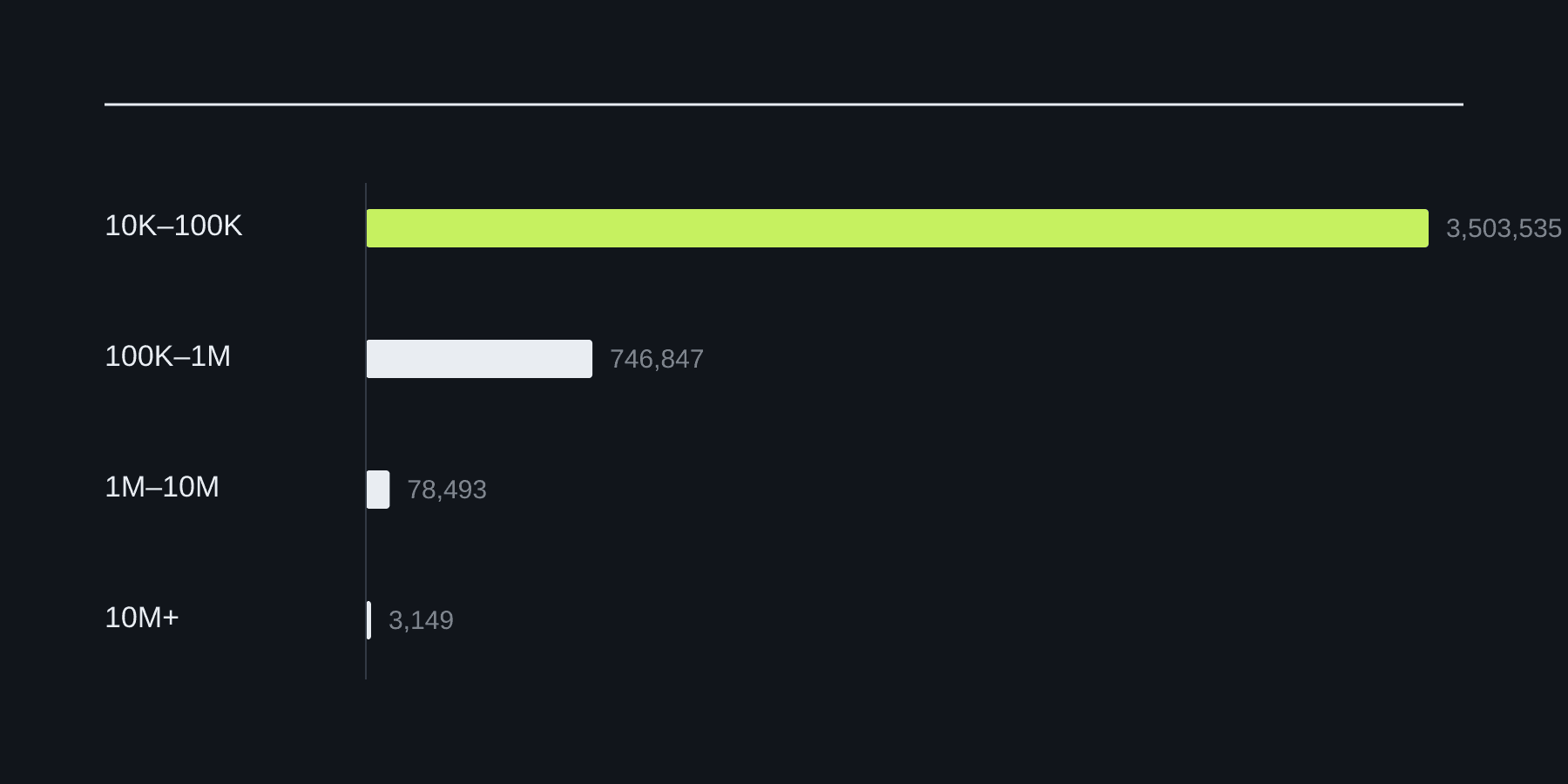
- 10,000 to 99,999 subscribers: 3,503,535 channels (80.9% of the tier)
- 100,000 to 999,999: 746,847 channels (17.2%)
- 1 million to 9.99 million: 78,493 channels (1.8%)
- 10 million or more: 3,149 channels (0.07%)
Each step up the scale holds far fewer channels than the one below it: about a fifth, then a tenth, then a twenty-fifth. The headline names that dominate coverage of the creator economy are a very small group: fewer than one channel in a thousand above the 10,000 line reaches ten million.
What the count is, and is not
These are channel records, not people or businesses. One creator can run several channels, and some large channels belong to media companies, record labels or broadcasters. The count also says nothing about activity: a channel can hold 10,000 subscribers years after its last upload.
For the share of records that never upload at all, see Most YouTube channels are audiences, not creators.
Why the numbers are rounded
YouTube publishes subscriber counts rounded to three significant figures. A channel with 10,049 subscribers is reported as 10,000, and one with 1,234,567 as 1,230,000. Tier boundaries are therefore exact on the published values but can move a channel by up to 1% of its true count. Reading public subscriber counts explains what that does to growth figures.